
Introduction
Implementing smart building technology, from occupancy sensors and IoT gateways to energy monitoring platforms, requires investment in devices, infrastructure, and system integration. Before signing off on any proposal, every company has to answer a question that often gets overlooked first: how will this investment be financed and recorded on the company's books.
The financing scheme a company chooses determines a lot, from who owns the equipment, to how the cost hits this year's cash flow, to how quickly the project can get management approval. Companies need to pick a scheme that fits their budget conditions and business goals, not just default to habit or whatever option a technology vendor happens to offer first.
There are two main approaches long used for technology investment decisions across every industry: CAPEX (capital expenditure) and OPEX (operating expenditure). This article covers what CAPEX and OPEX actually are, how each works in the context of smart building implementation, and what factors matter before choosing one.
What Is CAPEX and OPEX?
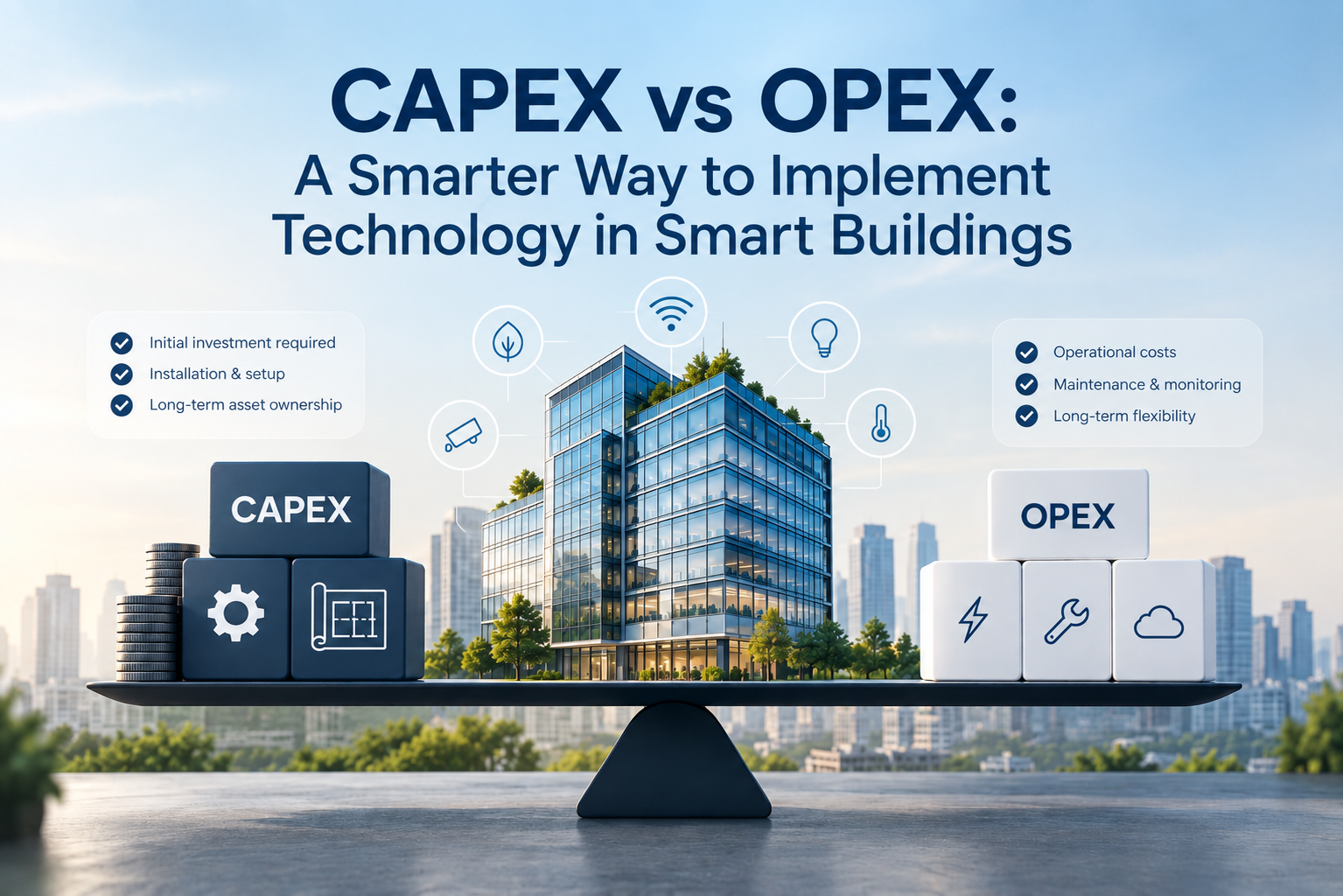
CAPEX (Capital Expenditure) is capital spending a company makes to acquire, build, or upgrade long-term assets such as hardware, infrastructure, or systems that will be used for years. On the books, CAPEX is recorded as an asset on the balance sheet and depreciated gradually over its useful life, rather than expensed all at once in the first year (FinQuery, 2026).
OPEX (Operational Expenditure) is the operating cost a company incurs to run day-to-day business, such as subscription fees, rent, or third-party services. Unlike CAPEX, OPEX is fully expensed in the accounting period it occurs, directly hitting profit on that period's income statement (FinQuery, 2026). Cloud-based technology subscriptions, including most smart building as a service solutions, are generally recorded as OPEX, though accounting standards such as ASC 350-40 in the United States allow certain implementation costs to still be capitalized as CAPEX (Kaseya, 2026).
The difference between CAPEX and OPEX shows up most clearly in three areas:
| Aspect | CAPEX | OPEX |
|---|---|---|
| Asset ownership | Devices and infrastructure become fully owned by the company | Devices generally remain the provider's property; the company pays for the right to use them |
| Payment pattern | Large upfront investment, recorded as an asset and depreciated over time | Recurring cost (monthly/annual), fully expensed each period |
| Technology management | The company handles its own installation, upgrades, and maintenance | Most management and upgrades are handled by the service provider |
CAPEX for Smart Building Implementation
Investment happens upfront for devices and infrastructure. Under a CAPEX scheme, a company buys sensors, gateways, and control devices directly, then records them as fixed assets to be depreciated over the following years.
Advantage: the assets belong to the company and can be controlled directly. Because the devices are fully owned, the company is free to decide system configuration, integration with other platforms, and upgrade timing without depending on a provider's policies.
Disadvantage: it requires a relatively large upfront budget. A CAPEX budget usually has to compete with other investment projects in the company, and approval often takes longer since it goes through a capital budget committee rather than routine operating costs.
Best suited to companies with an investment budget and a need for long-term asset ownership. This scheme makes the most sense for a company that already has annual capital spending allocated, plans to occupy the building long-term, and wants full control over the building automation system it installs.
OPEX for Smart Building Implementation
Technology cost is allocated as an operating expense. Instead of buying devices outright, the company pays a recurring subscription fee to use a platform and devices supplied by a third party, similar to a typical cloud service model.
Advantage: it reduces the need for upfront investment and offers flexibility. Since there's no large capital outlay upfront, OPEX projects are generally approved faster, and a company can start with the system that has the biggest impact first before expanding to others once the data proves its value.
Disadvantage: it carries ongoing costs and dependency on the service provider. Because payment continues through the contract term, the long-term total cost needs to be calculated carefully, and the company becomes dependent on the stability and support of its technology provider.
Best suited to companies that want to adopt technology without a large upfront infrastructure investment. This scheme fits a building that isn't yet certain of its long-term needs, wants to test the technology's impact first, or wants to keep cash flow flexible for other business needs.
CAPEX vs OPEX: Which One Fits Better?
Comparing the two is easiest through five angles: upfront capital, asset ownership, flexibility, maintenance, and scalability. CAPEX demands a large upfront capital outlay but grants full ownership and long-term control. OPEX keeps upfront capital low and flexible, but shifts ownership and part of the maintenance responsibility onto the service provider.
The building's age and the condition of its existing systems also shape the right choice. A new building built from the ground up is usually better positioned for CAPEX, since its infrastructure is designed for long-term investment from the start. An older building already running BAS/BMS, PLC, or SCADA is often better served by starting with OPEX, since new technology can read and connect to the existing system without a full upfront replacement.
The scheme chosen should also match the company's efficiency targets and business strategy, not just its current budget availability. A company pursuing investor recognition or long-term ESG compliance, for instance toward green building certification, may benefit more from asset ownership through CAPEX. Read the full guide on turning a conventional building into a green building. A company that prioritizes fast implementation and testing impact first is generally better served by OPEX's flexibility.
No single scheme fits every smart building implementation need. Both are equally valid, and the right decision depends on the combination of a company's financial condition, building condition, and operational goals.
Factors to Consider Before Choosing
Five things worth calculating before deciding on a smart building financing scheme:
- Total investment and operating cost: compare CAPEX's total cost of ownership (purchase price plus annual maintenance) against OPEX's total subscription cost over the same contract period.
- Energy savings target: commercial buildings in Indonesia are estimated to waste 30–40% of their energy to reactive operations, so projected savings from better energy management should factor into the ROI calculation, not just the upfront cost.
- Technology upgrade needs: consider how often the devices and software need updating, and who will bear the cost of those upgrades down the line.
- Internal capacity to manage the system: a facility team without in-house technical capacity for maintenance is generally better served by OPEX, where technical support is already bundled into the subscription cost.
- Future development and integration potential: make sure the chosen scheme doesn't close off the option to add modules or integrate new systems as the building's needs grow.
Conclusion
CAPEX and OPEX each carry their own advantages for smart building implementation. CAPEX grants full ownership and long-term control at the cost of a large upfront investment, while OPEX preserves flexibility and cash flow at the cost of ongoing fees and dependency on the service provider.
The best choice depends on each company's financial condition, technology needs, and operational strategy, not on which scheme happens to be more popular. A flexible smart building solution, one where a company can choose CAPEX or a subscription-based service depending on its own situation, helps a company start from its most urgent need without getting locked into one financing model from day one.
Frequently Asked Questions
What's the difference between CAPEX and OPEX in smart building?
CAPEX is capital spending to buy devices and infrastructure outright, recorded as an asset and depreciated over time. OPEX is a recurring subscription fee to use technology supplied by a third party, fully expensed each accounting period. The main differences come down to asset ownership, payment pattern, and who handles maintenance.
Is OPEX always cheaper than CAPEX?
Not always. OPEX lowers the upfront cost, but the total cost over several years can end up higher than buying the asset outright through CAPEX. A fair comparison has to calculate the total cost of ownership for both schemes over the same timeframe, not just the first year's cost.
When should a company choose the CAPEX scheme?
When the company already has capital spending allocated, plans to occupy the building long-term, and wants full control over the installed system without depending on a third-party provider's policies.
Can smart building implementation combine CAPEX and OPEX?
Yes. Many companies buy some core devices through CAPEX while subscribing to the platform and analytics through OPEX, matching the scheme to each system based on priority and available budget.
How do you calculate smart building costs over the long term?
Compare the total CAPEX cost (device price, installation, and annual maintenance over its useful life) against the total OPEX cost (subscription fee multiplied by the contract length), then offset both against the projected energy and operating cost savings the system delivers.
Choosing between CAPEX and OPEX doesn't need to be decided on paper before looking at your own building's actual condition.
Schedule a free, no-obligation site assessment. We'll map the systems you already have, project the cost and savings under both schemes, and show you the option that fits your budget and business goals best before you commit to anything.