
Introduction
By mid-afternoon, meeting rooms often feel stuffy: people yawn and the discussion slows. The cause is rarely temperature. It is usually air that has been breathed again and again for too long. Air quality affects employee comfort, health, and productivity, so indoor air quality (IAQ) should be monitored regularly, not guessed.
The US EPA notes that people spend about 90% of their time indoors, and that some pollutants can be two to five times more concentrated inside buildings than outside.
What Is Indoor Air Quality (IAQ)?
Indoor air quality is the condition of the air inside a building, judged by its gases, particles, temperature, and humidity, and by how these affect occupants. It is shaped by how much fresh air comes in, how many people share a space, indoor pollutant sources, outdoor air quality, and the state of the HVAC system.
The productivity link is well studied. The COGfx study from the Harvard T.H. Chan School of Public Health (2016) found office workers' cognitive scores roughly doubled when ventilation was increased and CO₂ and VOC levels were reduced.
Key Parameters for Measuring IAQ
- CO₂: the best indicator of whether ventilation keeps up. Outdoor air sits around 400–450 ppm; many guidelines treat roughly 1,000 ppm as a practical ceiling for workspaces.
- PM2.5 and PM10: fine particles from outdoor pollution, dust, and printers. WHO 2021 guidelines for 24-hour averages: 15 µg/m³ (PM2.5) and 45 µg/m³ (PM10).
- Temperature and relative humidity: the pair behind thermal comfort. Most workplace guidance aims to hold humidity somewhere between 40 and 60 percent.
- Carbon monoxide (CO): odourless, often from vehicle exhaust in car parks. WHO guideline: 7 mg/m³ averaged over 24 hours.
- VOCs: chemicals released by paint, adhesives, furniture, carpets, and cleaners; they usually spike after a renovation.
- Formaldehyde and others: measured as needed, for example in newly renovated buildings.
Indonesia sets its own indoor air limits under Health Ministry Regulation 2/2023 on environmental health; WHO and ASHRAE figures are useful for comparison.
How to Measure Indoor Air Quality in the Office
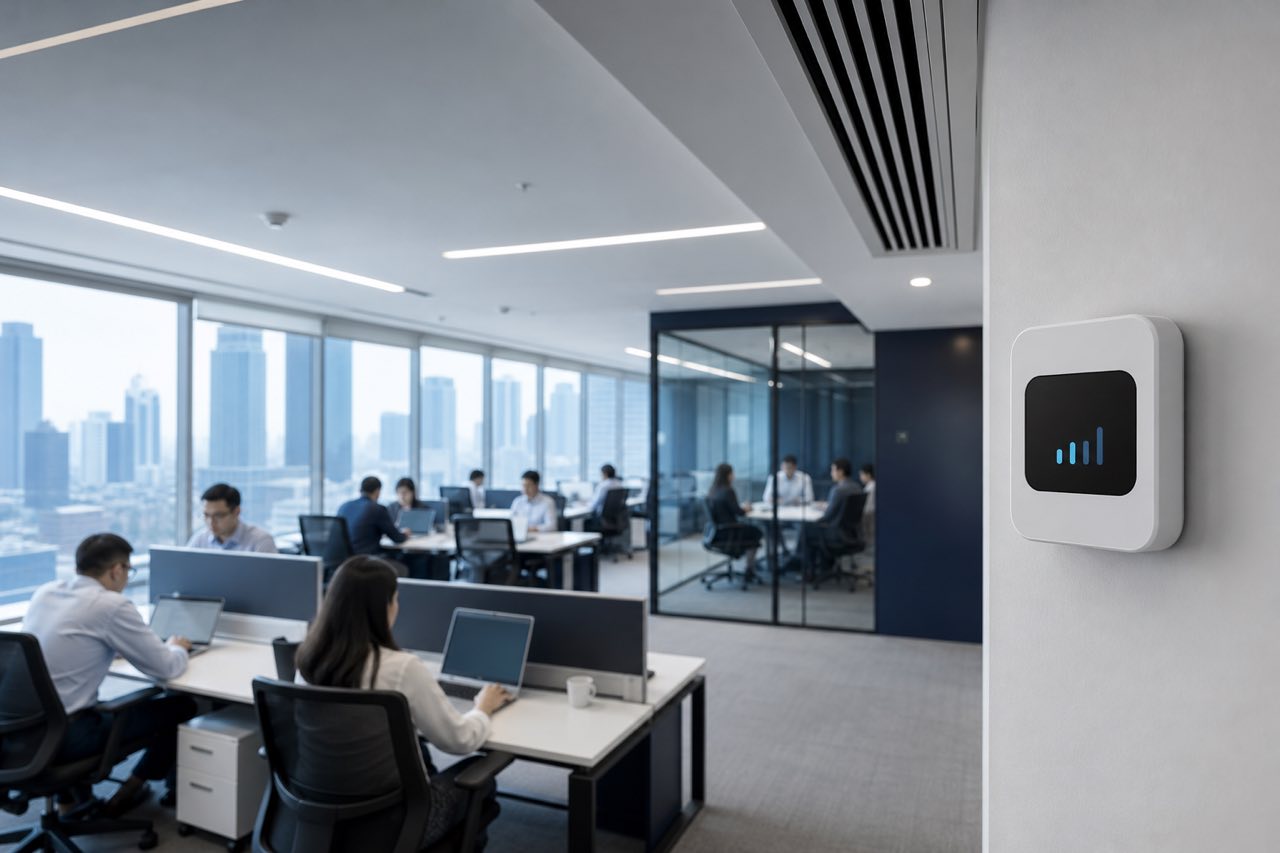
- Use IAQ monitoring sensors that read several parameters at once and log data continuously.
- Choose measurement points by floor area and room function. Mount sensors at seated breathing height, away from doors, windows, and direct airflow from the AC.
- Monitor during operating hours for at least one to two working weeks, since the worst conditions appear when rooms are fullest.
- Compare results with relevant standards and note which rooms and times exceed the limits.
- Identify patterns, such as CO₂ that always climbs after a meeting runs 45 minutes. Patterns point to root causes, not just symptoms.
Ferbos's Environmental Monitoring solution reads CO₂, particles, VOCs, and thermal conditions in every zone and turns them into data a facility team can act on.
Why Office Air Quality Deteriorates
- Poor ventilation and circulation, often because fresh-air supply is cut to save cooling load.
- Rooms holding more people than they were designed for.
- Dust from office activity and outdoor pollution carried inside.
- Emissions from furniture, carpets, paint, and cleaning products.
- Clogged filters and dirty coils from neglected HVAC maintenance.
How to Improve Indoor Air Quality in the Office
Indoor air quality improvement works best in stages, starting with whatever the data shows has the most impact.
- Optimise ventilation. Match fresh air to occupancy using CO₂ sensor readings (demand-controlled ventilation).
- Maintain filters and HVAC based on actual condition, not the calendar alone. Equipment Health Monitoring helps flag units that are starting to decline.
- Control pollutant sources: printers in rooms with exhaust, low-VOC paint, and extra ventilation after renovation.
- Keep humidity below 60% to prevent mould, which matters in a tropical climate.
- Monitor in real time so the facility team is alerted before complaints arrive.
- Integrate with your BMS. With building automation, fresh-air dampers and fan speeds adjust automatically to sensor data.
Healthy air does not have to waste energy. Through HVAC optimisation, fresh air goes where and when it is needed. In one Jakarta low-rise office, data-driven AC control through Continuum cut energy costs by 24.4%, while the temperature in an occupied work room improved from 26.2 °C to 25.7 °C.
FAQ
How often should office air quality be measured?
Ideally continuously, with permanent sensors. Otherwise at least twice a year, and after a renovation or a headcount increase.
Are indoor plants effective at improving air quality?
Their effect is very small. Matching ordinary mechanical ventilation would take far more plants than any office could hold.
What is the difference between a CO₂ sensor and an air quality sensor?
A CO₂ sensor only judges ventilation. An air quality sensor reads several parameters at once, such as PM2.5, VOCs, temperature, and humidity.
Does an air conditioner alone keep office air healthy?
No. Many AC units simply cool and recirculate the same air without adding fresh air.
When does an office need an integrated IAQ monitoring system?
When a building has many zones, stuffiness complaints keep recurring, or the company is pursuing green building certification and ESG reporting.
Measuring IAQ shows a company what its people are actually breathing and where pollutants come from. Monitoring sensors, the right ventilation, and HVAC automation together keep office air healthy. Ferbos supports this through Continuum, which reads existing BAS/BMS, PLC, or SCADA systems without replacing them, or installs the sensor layer from scratch where none exists. See how it applies to office buildings.
Want to know what the air in your office is really like? Book a free site assessment with Ferbos.