
Energy costs continue to rise across Indonesia. For commercial buildings, factories, hotels, and mixed-use developments, electricity can account for 25–60% of operational expenses.
Yet many facilities still operate without real-time visibility into how energy is consumed.
A Building Energy Management System (BEMS) changes that.
It transforms raw energy data into actionable intelligence — enabling businesses to reduce costs, improve efficiency, and integrate energy performance directly into financial reporting systems.
The Energy Waste Problem in Indonesian Buildings
Many Indonesian buildings face common challenges:
- No real-time energy monitoring
- Manual reporting and delayed data
- Overloaded HVAC systems
- Poor power quality visibility
- Lack of integration between technical and finance teams
Without data-driven control, energy waste can reach 15–30% annually.
For industrial facilities, uncontrolled peak demand alone can significantly increase electricity bills due to demand charges.
A modern BEMS addresses these issues holistically.
What Is a Building Energy Management System (BEMS)?
A Building Energy Management System is a centralized platform that monitors, analyzes, and optimizes energy usage across a facility.
It integrates:
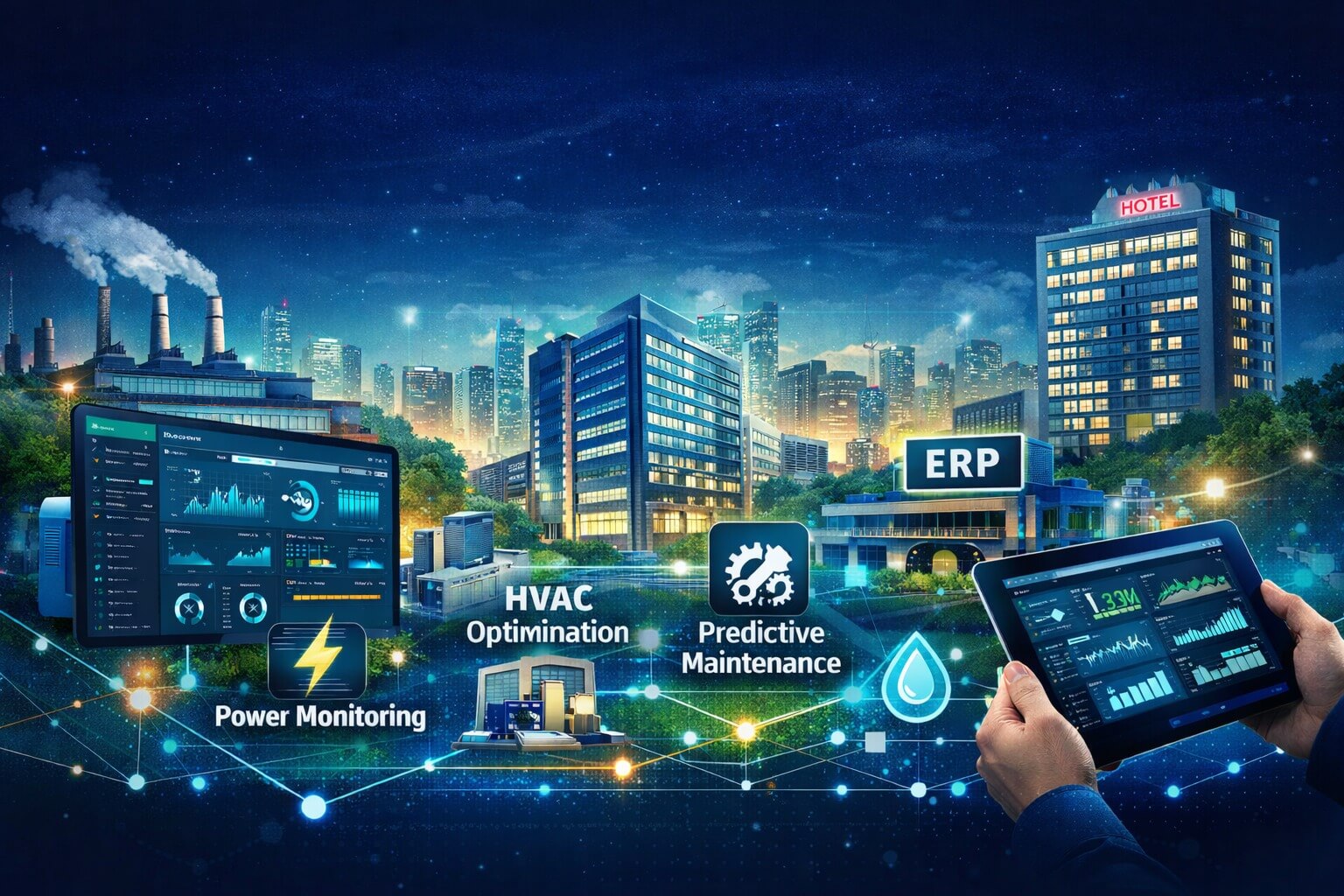
- Power monitoring systems
- HVAC monitoring and optimization
- Chiller plant control
- Environmental monitoring sensors
- Equipment health monitoring
- Water management systems
Unlike traditional control systems, BEMS focuses on performance intelligence and measurable cost reduction.
How BEMS Reduces 20–30% Energy Cost
1. Real-Time Power Monitoring
Continuous monitoring of:
- Voltage
- Current
- Power factor
- Harmonics
- Load distribution
This prevents overload, imbalance, and inefficiency.
2. HVAC Optimization
HVAC accounts for up to 50% of building energy usage.
Through:
- AHU monitoring
- Chiller plant optimization
- Automated HVAC control
- Predictive maintenance
Energy waste is minimized while maintaining comfort levels.
3. Demand Control Management
Peak load monitoring enables:
- Load shifting
- Demand limiting
- Automatic alerts before peak penalties
This alone can reduce 5–15% of total electricity bills in large facilities.
4. Equipment & Condition Monitoring
By tracking performance patterns:
- Motors
- Pumps
- Compressors
- Electrical panels
BEMS enables predictive maintenance instead of reactive repairs — reducing downtime and maintenance cost.
Office vs Factory Energy Management
Office Buildings
Focus areas:
- HVAC optimization
- Lighting automation
- Tenant energy billing
- ESG reporting
BEMS ensures transparent allocation of energy costs and sustainability tracking.
Industrial & Factory Facilities
Focus areas:
- Production line energy tracking
- Machine-level power monitoring
- Demand charge control
- Equipment health monitoring
For factories, even 3–5% improvement in efficiency can translate to significant annual savings.
BEMS vs Traditional Building Management System (BMS)
Traditional BMS primarily controls equipment.
BEMS goes further by:
- Converting operational data into financial insights
- Providing ROI analysis
- Integrating with ERP systems
- Enabling energy cost allocation
- Supporting sustainability compliance
In short:
BMS = Control
BEMS = Intelligence + Cost Optimization
ERP Integration: Connecting Energy to Financial Performance
One of the most powerful features of modern BEMS is ERP integration.
With integrated systems:
- Energy costs can be allocated per department or tenant
- Automatic invoicing can be generated
- Real-time cost dashboards are available
- Energy KPIs align with financial reporting
This transforms energy management from a technical function into a strategic business function.
ROI Example: Industrial Facility Case
Assume:
- 1 MW peak demand
- 24-hour operation
- 10% HVAC efficiency improvement
- 5% demand reduction
Estimated results:
- 15% overall energy cost reduction
- Payback period: 12–24 months
For large facilities, savings can reach billions of rupiah annually.
Why Indonesian Companies Are Moving Toward BEMS
- Rising electricity tariffs
- ESG and sustainability reporting requirements
- Pressure to reduce operational costs
- Digital transformation initiatives
- Competitive advantage in efficiency
Energy intelligence is no longer optional — it is strategic infrastructure.
Start Building Energy Intelligence Today
A modern Building Energy Management System is not just about monitoring.
It is about:
- Optimization
- Automation
- Financial integration
- Predictive maintenance
- Long-term operational efficiency
If your building or facility lacks real-time energy visibility, you are likely paying more than necessary.
Now is the time to transform energy data into measurable savings.